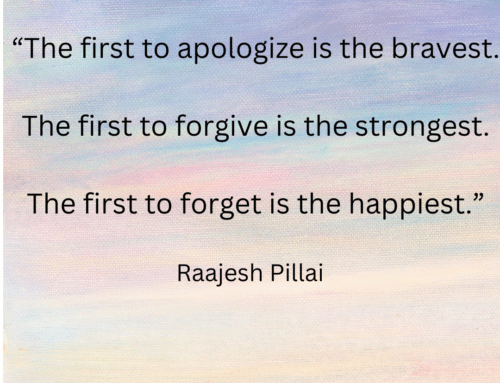
When someone gets angry with you or accuses you of something, your first instinct is to defend yourself. We want to protect ourselves, because clearly there has been a misinterpretation of our actions. Yet defensiveness is the worst way to clear up conflict.
Reaction to defensiveness
If the first thing you do is to defend yourself, when the other person is upset, it will only make them angrier. This leads the other person to raise their voice. They want to be heard and understood. Denying your actions or making excuses (even though they might be valid) will only make the other person angrier.
Antidote to defensiveness
According to John Gottman Phd. (relationship expert) the antidote to defensiveness is to accept responsibility. Realistically when we have conflict with someone we each play a piece in it. In order to move forward we need to admit our part. Now if you are not sure what you did wrong, ask for clarification. Then listen. It could be that you were doing something to make your partner happy and they misunderstood your actions and intentions.
Example of how to accept responsibility
Let me give you an example. Patience is not my strong point. So I may be acting impatient and one of my kids might tell me that I’m being impatient. I can deny it, and say I am not. Or I can reply something along the lines of, “You are right, I am being impatient. I need to keep working on that.” On the flip side, my husband has the patience of a saint. I can admit that I will never reach his level of patience, as I’m a type A personality. However, I can strive to be like him, yet I will never achieve it.
Best outcome of accepting responsibility
In the best-case scenario, once you accept responsibility, the other person will soften and admit their part in the interaction. Now there is no guarantee that they will do that. However if you do your part, you will know you have done your best, no matter how the other person responds. If they do their part, your conflict will truly be resolved, and you will feel closer to that person.
How to get your partner to hear your side
If you want your partner to hear your side of things, the first thing you want to do is to acknowledge that you hurt the other person. It may not have been your intention, but you did something that hurt them. A simple apology will do. Something like “I’m sorry I hurt you.” Saying something such as, “I’m sorry you feel that way,” will not do. Responding in this manner makes it sound as if its the other persons issue and you had nothing to do with it.
Once you admit your piece in the interaction (even if you have a totally different interpretation of the situation) the other person may be calm enough to hear your side of the story. Once they feel heard and understood they will be calm enough to hear any kind of explanation as to what went on from your perspective.
Impact of defensiveness
I know this is all easier said than done, as our natural response is defensiveness. Yet, it drives a wedge in relationships, by closing the door to any meaningful conversation or change. However, this is something we can all work on. Remember, we are creatures of habit and the first step to change is to recognize that we are doing something that is toxic to our relationship. In most cases we did not intend to offend the other person, and it’s just a silly misunderstanding. Most people argue about the smallest little things. Often times when I do couples counseling the couple will want to recap their previous conflict. Sometimes these are so small that the couple can’t even remember exactly why they were fighting.
Denial of defensiveness
Some people deny that they get defensive. Perhaps they are being defensive about being defensive. Realistically we all do this. When someone points something out that isn’t going well, it hurts. None of us wants to open ourselves up to that.
How to address recurring problems
There may be some problems that reoccur in your relationship, topics that you want to avoid because you know they will lead to conflict. These are still important to address. They will not go away on their own. Perhaps setting up a time to discuss one of them will help prevent defensiveness. You know you will be discussing these issues and you can come to the table calmly and with a clear head, wanting to better understand your partner’s point of view.
Don’t bring up the past
The last thing you want to do is to remind your partner of their past indiscretions. This will prevent you from resolving that current conflict. The longer we have been together the longer the list of indiscretions become. None of us is perfect and we will make mistakes.
If conflict or defensiveness is getting in the way of your relationship, individual our couples counseling may help. Give me a call at 713-304-6554 and we can work on it.
Take care,
Debbie