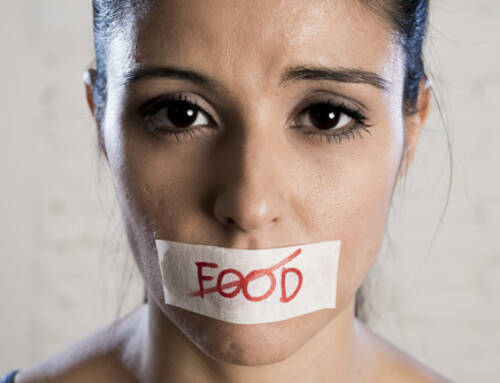
Family gatherings can be challenging due to different family dynamics. People might have varying ideas of how the holidays should be spent. In addition, if you have trouble coping with an eating disorder it can add a very different dimension to the holiday meal.
Many emotions or fears may arise. You may worry about what others will think, or what they will say about how much or how little you eat. Perhaps you fear they will say something or make a comment that will trigger you. These are all valid concerns. The thing that is most important is that you take care of yourself.
Tools for coping with an eating disorder
Eat mindfully
These foods are usually delicious, so whether you tend to eat too much or too little, this is a great tool. Look at the texture and color of the food. How does it smell? Put a small bite in your mouth. Notice its taste, temperature and texture. Slowly chew the bite and savor the flavor. Then swallow it.
It is so easy to eat quickly when it tastes so good. However, after the first few bites, you no longer taste the foods. That is why it will be more enjoyable if you can eat mindfully.
Don’t skip a meal prior to the holiday feast
If you don’t eat anything until the big meal, you will be starving and more likely to overeat or binge.
Allow yourself to sample the foods
The holidays are a time where we tend to make foods we don’t make during the rest of the year. Or we might have a traditional meal or dish that we make for the holidays.
Don’t deny yourself these things. Have a small bite so you can at least enjoy it. If you tend to overeat, just take small portions.
Goal setting and coping with an eating disorder
Perhaps trying every dish is overwhelming for you. Set a small goal. Perhaps it is to try one new dish. Or maybe it is to allow yourself to have some dessert. You decide what it will be. There is no wrong or right here.
Bring a dish
If you worry about all the foods that will be there that trigger you, why not bring a dish? This is something that you like and won’t trigger you in the way the other foods might.
Find a safe space
If you are worried about what others will say and think, create a safe space in your home, or wherever you might be going. It is OK if you want to take your plate into another room to eat. The holiday is much more than just food.
Don’t focus on the food if you are coping with an eating disorder
Yes, there is typically a big meal or many foods that can trigger you if you struggle with an eating disorder. However, the holiday is about much more than the food.
The main purpose of the gathering is to see people you don’t get to see that often. Spend one on one time with your favorite people. The fun, fellowship and connection with your loved ones is what most important.
Have a designated person who is on your side
This can either be at the gathering or someone you can call or text. If you are having a difficult time, are struggling, or not sure how to handle a situation, go to this person. This will serve as a safety net. If they are at your gathering, plan to sit next to them. You are not alone.
Boundaries
If there is someone in the family who does not respect your boundaries or gives you are hard time, try to steer clear of them. If this is not possible, then keep conversations to a bare minimum.
Remember, boundaries are to protect you, not make others happy. They may not like what you say or do, and that is OK.
Ways to respond
Thinking of some ways to respond if someone triggers you can be helpful. We can’t predict every scenario that might pop up, but having one of two responses planned out ahead of time can be helpful.
You can even let the person know that you are not comfortable having that conversation. If they keep on going, it is OK to just walk away.
Self-care for coping with an eating disorder
What tools do you have for self-care? Do you like to meditate, practice mindfulness, journal, or do yoga? Perhaps you garden, are crafty or play an instrument. Others like to get manicures, pedicures or massages. Honor yourself and practice whatever self-care you need for the holidays.
Educate your family
Provide them with information on eating disorders. If you are coping with an eating disorder let them know what will help you and what won’t. This way your family will know how to best support you. Tell them about your triggers. Give them specific examples of what others might say that trigger you, such as, “I’m a pig, I can’t believe I ate so much”, or “Is that all you are going to eat?”
Resources for coping an eating disorder
National Eating Disorders Association (NEDA)
National Association of Anorexia Nervosa and Associated Disorders (ANAD)
International Association of Eating Disorders (IAEDP)
Houston Eating Disorders Specialists
Get professional help
Many people suffer for years prior to getting help. If you struggle with an eating disorder, it is never too soon or too late. Food does not need to control your life. Please give me a call at 713-304-6554 if I can help.
Take care,
Debbie