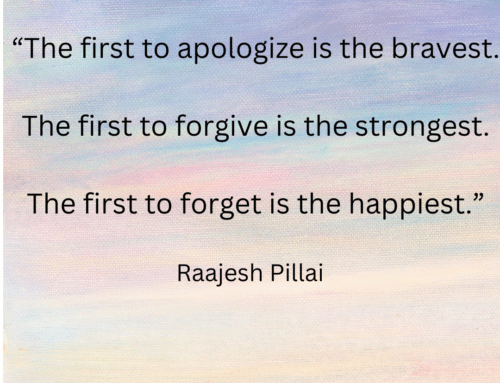
Do you know how to truly forgive someone? Learning to do so has many benefits to your mental health. Some people can only feel the hurt, or the injustice done to them. Forgiveness certainly doesn’t mean that you forget what happened or condone the behavior.
However, when you forgive, you let yourself off the hook. You aren’t as emotionally attached to the situation and can be more at peace.
Research shows that forgiveness is good for your well being. In a study presented at Harvard (Ho, et al., 2023), participants were given a forgiveness workbook that included various exercises. First, they were told to write a story about someone who hurt them and wanted to forgive. Second, they were told to write the story again. This time they were to take the perspective of an observer, without noting any feelings that came up. Finally they were instructed to write down 3 differences between the two stories.
Results showed that this group of people was more able to forgive than those who didn’t write in the journal. In addition their symptoms of anxiety and depression went down. Other research shows that it can improve sleep as well as decrease stress.
You may wonder how to work on forgiveness. It may not come easy, but it is a skill that you can hone.
How to forgive
Become ready to forgive
The first step might be to work on reducing your anger towards that person. I once heard that resentment was like drinking battery acid and expecting the other person’s stomach to rot out. Clearly our anxiety or anger is harming us more.
It helps to stop saying negative things about the other person in your head, or out loud to others. Don’t focus on getting even or doing something harmful to the other person. This just stirs up the pain and anger.
Reflect upon your pain
Acknowledge that you are hurt or feel betrayed. What caused you pain in the situation? Did it poke at an old wound or unearth some insecurity? Perhaps it reminded you of something that happened in your childhood that is unresolved. There is something about this situation that sticks. It feels more than a minor injustice that you can let go of. Perhaps you misinterpreted the situation or the other person is acting out of his or her own pain.
Empathy
My guess is the other person didn’t intend to hurt you. What was going on in their life that made them behave in a way that hurt you? Just imagining these kinds of scenarios can help you soften towards the other person.
Again, this doesn’t mean that it was OK for them to hurt you. It just helps you to understand what was going on from their perspective.
Sometimes it helps to journal. It can move you from your emotional brain to your logical brain. There is no wrong or right way to do this. Just follow your gut. Perhaps write about the event, how you felt and how it impacted you. Then see if you can understand the other person’s point of view and why they did what they did.
Did you learn anything?
Perhaps over time you may be able to realize that you may have played a part in the situation. Did you do anything that may have led the other person to react in the way that they did? This isn’t to blame you for any wrong doing-just to better understand the situation.
Perhaps you realized your boundaries aren’t as firm as they need to be. You may have done something to be sure that you aren’t in this situation again. Or maybe you have softened towards other people’s pain.
Ask for help
Based on what happened to you, forgiveness may be difficult or near impossible. If you are unable to forgive, it doesn’t mean that you are a bad person or a failure.
You can talk to other people who are loving and supportive. You can also reach out to a clergy member or therapist. Just knowing that they are there for you can be helpful.
Forgive yourself
Maybe the person you need to forgive is yourself.
We have all done things that have hurt other people. Most of the time this is unintentional. Remember, you are human and you are going to make mistakes. You can look at all the steps above and apply them to yourself.
Understand why you acted in a way that hurt someone else. Again, this isn’t to make excuses but to gain knowledge about your past and what makes you tick. We are all products of our environment and have wounds from our childhood. Most of us are just trying to get our needs met. Sometimes we do these in unhealthy ways until we can learn otherwise.
If you are having trouble letting go or forgiving, therapy can help. In addition it often helps to talk to someone who isn’t emotionally involved in your situation. Please give me a call at 713-304-6554.
Take care,
Debbie