It is impossible to have a long-term relationship without getting into arguments at some point in time. The health or success of your relationship doesn’t depend on whether you argue or not, but how you argue and how you resolve conflict. This makes all the difference in settling your issue or letting it go.
Sometimes we have to agree to disagree. It’s important that you are able to understand your partner’s point of view, even though it isn’t your own.
How to resolve conflict
Take a little time and space
When we are in conflict we are angry and can only see our own point of view. This is not the headspace to be in if we want to resolve conflict. We can only do so when we have calmed down and recognize that our partner also has a valid point of view.
Also it’s important that you do come back and discuss the issue; so don’t let it fester for too long. One of you can even say, “Why don’t we take a break from this and come back and talk again in an hour?”
Reflection
Take some time to reflect upon what happened. Did something trigger you? Were you in a bad mood? Try to understand why you had the reaction that you did. Think about the role you played in the conflict. Remember it takes 2 to argue, it doesn’t occur in a vacuum. Perhaps you overreacted.
Apologize to resolve conflict
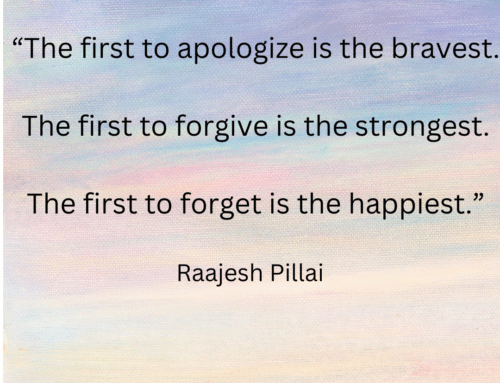
As mentioned above, it takes 2 to argue. Apologize for the piece you played in maintaining the conflict. It can be as simple as saying, “I’m sorry I was snippy with you,” or “I’ve had a really rough day and my patience is running thin.” Often times when we admit our mistake and offer a sincere apology, our partner will do the same. Or they might forgive us. Realistically most of the things we argue about are silly.
Set a time to come back and talk
If there is something that you need to work out, or if you feel you haven’t been heard or understood, set a time to talk about it. This way you will both calm down and can have clear heads to understand each other better.
Remember when we make ourselves vulnerable with our partner it brings us closer together.
Practice active listening
John Gottman PhD has a wonderful template for this. One person is the speaker and the other person the listener.
The speaker says their piece using the following template: When you_____, I feel_____, and my positive need is ______.
Being the listener is actually harder because your job is to keep quiet, listen to what they are saying and use this template:
So what I heard you say is you feel_____ when I ____ and your positive need is_____. Then add the following sentence:
It makes sense that you would feel that way because_____. This last step is critical in validating the other person. Remember you might not see things like your partner does, but it is their point of view you are validating.
Common ground
If you are trying to work on a solution, do you both agree on some part of it? Or perhaps you have the same end goal, but have different ways of achieving the goal. Finding this commonality can help reconnect the two of you.
Seek to understand
If you can’t understand your partners point to view, calmly ask questions to help you better understand. Remember, our points of view come from what the world has taught us. This is different for all of us. You can say something along the lines of, “Is there something I did to make you feel that way?” or “I’m not sure what happened, can you please help me better understand.”
Remaining calm and patient is critical here.
Forgive to resolve conflict
Letting go and forgiving someone will bring the 2 of you closer together. It will prevent you from holding a grudge. I once heard someone say, “Holding a grudge is like drinking battery acid and expecting the other persons stomach to rot out.”
Thus, forgiveness is actually something you do for yourself.
Continue to work on communication
Is there something you can do to prevent a similar conflict from happening? Often time’s couples get into an unhealthy pattern with their arguments and have trouble breaking it. All it takes is for one person to change the dynamic for the whole system to change.
Communication is the main reason couples come in to therapy. If this is something you struggle with, please give me a call at 713-304-6554. There area all kinds of tools I can teach you for resolving conflict.
Take care,
Debbie