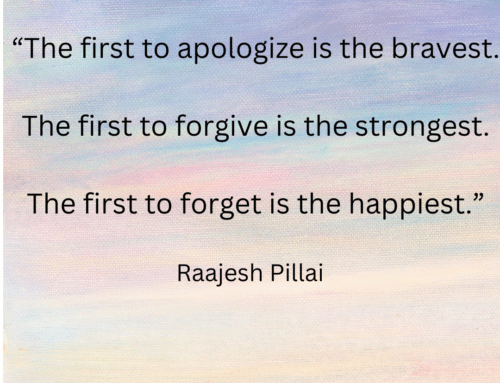
Is forgiveness something you struggle with? Do you tend to hold a grudge? Some people find forgiveness more difficult than others, especially after a betrayal. Some think that if you forgive someone it means that you also forget it. Others think that it means you condone the behavior. It is possible to forgive. I don’t know that anyone forgets when someone has really hurt you. However, over time the sting tends to decrease. To forgive someone does not mean that you are saying the behavior is OK.
Functional/dysfunctional forgivenesss
Dysfunctional forgiveness
If you think about it forgiveness can be functional or dysfunctional. Your forgiveness may be dysfunctional if you do it too quickly just as a way to preserve the relationship. Perhaps you avoid conflict at all cost, so you just tell the other person it is OK, even though it may not be. This may appear insincere. It also sets you up to be mistreated again.
Another way it is dysfunctional is if you use it to control the relationship. Perhaps you see it as a sign of weakness and you remain rigid in refusing to forgive some type of betrayal. It lets you focus on the imperfections of another, and not on your own. You may be passive-aggressive and try to get back at the other person without letting them know why. This only increases the wall between the two of you.
Functional forgiveness
Functional forgiveness is genuine. The person who has been hurt processes the betrayal, and the person who has hurt the other person takes responsibility and acknowledges the other persons pain. You are also able to understand your feelings throughout the process, and are both able to resolve what happened. Perhaps you each played a part in it, or it was due to a misunderstanding. At this point in time, you aren’t fixating on the subject.
Tasks needed for forgiveness
According to Janis Abrahms Spring, PhD there are 6 tasks necessary for forgiveness. They include looking at what assumptions get in the way of forgiveness such as: you feel you deserve to be forgiven, don’t deserve to be forgiven or nothing you do will lead to you being forgiven, so why bother trying? Next you need to look at the pain you inflicted. This means you allow the person to share their pain. You listen and validate their feelings. You need to provide a sincere apology. This includes acknowledging specifically what you did wrong and how your betrayal affected your relationship. It’s important that you have a soft tone in your voice.
How to tell if the apology is sincere
We can tell when our partner is truly sorry, based on the tone in their voice. Be sure you don’t use the word, ‘but’ as you negate everything you have said prior to the ‘but’. It is also important that you let your partner know that you will not do it again. Try to understand why you did what you did and share it with your partner. Share your shortcomings or things you are not particularly proud of. See if you can understand where you learned to behave as you have done.
How to earn trust after a betrayal
You also need to earn the trust of the injured party. There are some easy things you can do and some difficult things you can do. Easy things include allowing your partner to see your phone bill, your cell phone password, and changing your phone number. Based on what happened you might need to do some very difficult things such as change jobs, or move into a different neighborhood. Ask your partner what they need from you to move forward in the process.
How to forgive yourself
You may need to forgive yourself for hurting someone you love. This means you look at yourself and get rid of the rationalization of what you did, and be open and honest. Perhaps you grew up in an abusive household, or did not have good role models. While this doesn’t excuse your actions, it helps to explain them. Perhaps you can learn to be compassionate with yourself. You begin to realize that you are more than your mistakes. Remind yourself of the good qualities you possess. Also remind yourself that by making amends with the other person, it says something about your willingness to work on your character.
If forgiving or being forgiven is something you are struggling with, please give me a call at 713-304-6554.
Take care,
Debbie Grammas PhD